

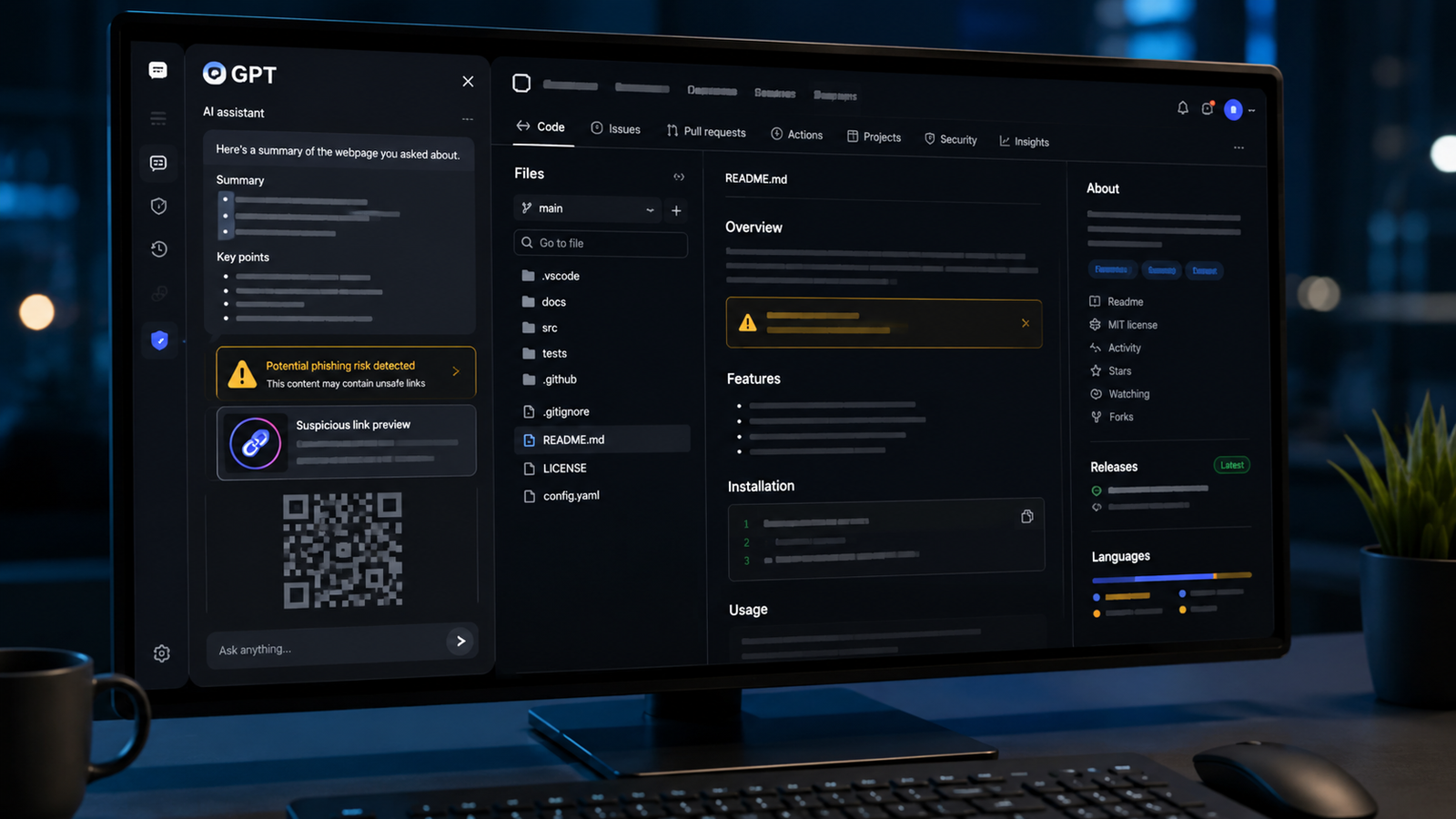
ChatGPhish Vulnerability Turns AI Web Summaries Into a Phishing Risk
Security researchers have disclosed details of a new technique called ChatGPhish that could allow attackers to turn AI-generated web summaries into a phishing surface by abusing how links and images are rendered inside assistant responses.
The issue is related to the way web content can be summarized by AI tools. When a user asks an AI assistant to summarize a web page, the assistant may process content from that page and present it back inside a trusted chat interface. Researchers found that specially crafted content on a web page could influence the generated summary and cause clickable links or images to appear inside the response.
According to the research, the technique takes advantage of Markdown rendering, a common formatting method used to display links, images, and structured text. If attacker-controlled Markdown content is included on a page, it may be reflected inside the AI-generated summary in a way that makes the final response appear trustworthy to the user.
This creates a new phishing concern because the malicious content would not appear as a normal suspicious email or external website link. Instead, it could be displayed inside a familiar AI assistant interface, where users may be more likely to trust what they see.
Researchers described the technique as a prompt-injection-related issue. In this scenario, the attacker does not need to compromise the user’s account directly. Instead, the attacker places specially crafted content on a web page and waits for a user to ask the AI assistant to summarize that page. If the content is processed and rendered in the response, the page itself becomes part of the attack path.
The reported impact could include phishing links being displayed inside AI-generated summaries, fake security warnings, misleading prompts, or image-based content designed to encourage users to click. Researchers also noted that externally loaded images may expose technical request data such as IP address, user-agent, and referrer information.
The discovery highlights a growing security challenge for AI products that browse, summarize, and render external web content. Traditional phishing attacks usually rely on email, messaging platforms, or fake websites. This technique shows how AI-generated summaries can become another surface for social engineering if untrusted web content is rendered without enough filtering.
The issue is also significant because AI assistants are increasingly used by individuals, employees, researchers, and business teams to summarize articles, reports, documentation, and web pages. As users depend more on AI-generated summaries, attackers may look for ways to manipulate the content that appears inside those summaries.
Researchers said the vulnerability was reported through a coordinated disclosure process before public details were released. At the time of public reporting, questions remained around whether the issue had been fully addressed.
The case adds to a wider discussion about prompt injection and AI security. Unlike traditional software bugs, prompt injection abuses the way AI systems interpret and respond to external instructions or untrusted content. When combined with web browsing and rich content rendering, the risk can become more serious.
Security experts have warned that AI systems should treat external web pages as untrusted input, especially when the final output includes active links, images, or interactive elements. Without strong separation between summarized content and clickable rendered elements, users may have difficulty distinguishing safe AI output from attacker-influenced content.
The ChatGPhish disclosure shows that AI security is not only about preventing harmful prompts. It is also about controlling how AI tools handle, display, and transform content from the open web.
As AI assistants continue to become part of daily browsing, research, and workplace activity, the security of generated summaries will remain an important area for both AI providers and cybersecurity teams.
Source: Security research reports